
Choose Your Job Site Unit: Storage Container or Portable Office Trailer Rental
A storage container protects tools and materials. An office protects the people who run the job. Many sites need both, and some need them in one box.
This guide helps project managers order the right unit the first time, and prep the site before it arrives.
Key takeaways
- Order a storage container when you only need to lock up tools, materials, and equipment.
- Order an office when you hold meetings, review plans, or host inspectors on site.
- Order a 40-foot office and storage combo when the site only fits one unit.
- Order the high security 20-foot office when the site sits empty at night and theft is a concern.
- Line up power before delivery. Every Premier office has a 100 amp circuit panel, but your electrician makes the connection.
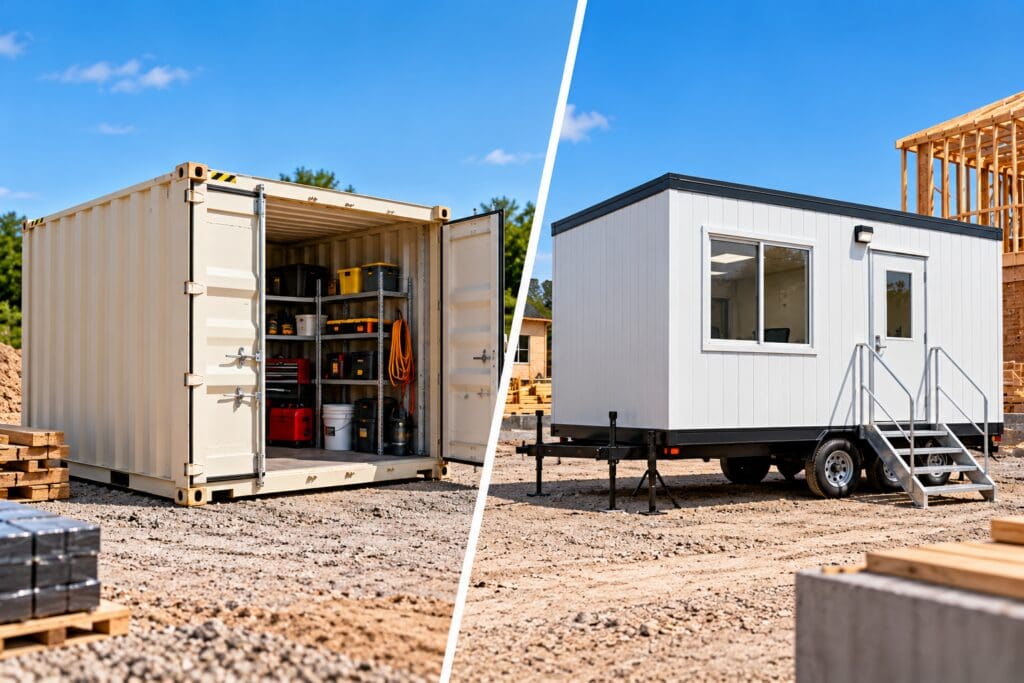
Start With the Job, Not the Unit
Three questions decide what to order:
- Will anyone work inside the unit? If people read plans, run meetings, or sit at a desk, you need an office. If the unit only holds gear, a storage container is enough.
- How much room does the site have? A tight lot may only fit one unit. That points to a combo.
- What happens after hours? A site in a busy area or with no fence changes your security needs.
Answer those three and the choice gets simple.
When a Job Site Storage Container Is Enough
A job site storage container is the right call when the work happens outside the box. It holds tools, materials, and equipment behind lockable steel doors.
Crews open it in the morning and lock it at night.
A storage container works well for:
- Power tools, compressors, generators, and ladders.
- Weather-sensitive materials like drywall, flooring, cabinets, and fixtures.
- Secure overnight storage so crews skip the daily truck load.
Premier rents 20-foot and 40-foot containers for commercial mobile storage on job sites. Not sure which length fits your gear? Our guide on how to pick the right storage container size walks through it.
For more on how storage saves time on site, read how portable containers improve job site efficiency.
When You Need a Mobile Office Container for Your Construction Site
You need an office when the job needs a place to think, not just a place to store. Signs you need one:
- Plan reviews: drawings need a flat, dry table.
- Inspections: inspectors expect a place to review permits and paperwork.
- Crew meetings: morning huddles run better out of the weather.
- Subcontractor coordination: trades need one spot to check schedules and changes.
- Climate control: laptops, printers, and people all work better at a steady temperature.
A mobile office container for your construction site gives you that room. Every Premier office is insulated and ground level. Each one has heat and air conditioning, interior lighting, an exterior light by the entry door, and a 100 amp circuit panel.
Ground level matters. A towable office trailer usually sits up on its chassis, so people climb steps to get in. A container office sits on the ground, so crews, clients, and inspectors walk right in.
Compare the three office options on our portable office containers page. Here is the short version:
| Unit | Interior office space | Windows | Best for |
| 20-foot office | 18′ x 7′ | Four, plus a lighted entry door | Sites that need a full-size office |
| High security 20-foot office | 15’6″ x 7′, plus a 3′ x 7’6″ storage area | One, next to the entry door | Sites left empty at night |
| 40-foot office and storage combo | 16′ x 7′ office, plus 22′ of storage | Four, plus a lighted entry door | Tight sites that need both |
The Combo Unit: Office and Storage in One Footprint
An office and storage combo unit puts a working office at one end and secure storage at the other. Premier’s 40-foot combo has a 16′ x 7′ office and 22 feet of wind and water tight storage.
The combo makes sense when:
- The site has room for one unit, not two.
- You want one delivery and one pickup instead of two.
- The same person manages the paperwork and the tool crib.
The trade-off is length. A 40-foot unit needs a longer, straighter path for delivery than a 20-foot unit. Check your access before you commit.
Standard Office vs. High Security Office
This is the choice most contractors don’t know they have. The two 20-foot offices look alike from the outside, but they lock up in very different ways.
The standard 20-foot office has a central, lighted entry door and four exterior windows. It gives you the most floor space and the most daylight. It fits sites with a fence, a guard, or steady traffic after hours.
The high security 20-foot office puts the entry door and its window inside the container’s own lockable steel doors. When the crew leaves, you close and lock the steel doors over the office entry. The office door and its window then sit hidden behind steel. The unit has no other exterior windows.
Here is what you gain and give up:
- You gain: no exposed entry door or glass when the unit is locked.
- You gain: a 3′ x 7’6″ storage area between the steel doors and the office door.
- You give up: about 2.5 feet of office length, at 15’6″ x 7′.
- You give up: daylight, since the unit has one window instead of four.
Choose the high security office when:
- The site sits empty overnight or on weekends.
- The office holds laptops, plans, survey gear, or other high-value items.
- The site is remote, unlit, or has had break-ins before.
If your site has a fence and people around at night, the standard office gives you more room and light.
Power, Heat, and Lighting: What to Have Ready Before Delivery
Every Premier office ships with a 100 amp circuit panel. Heat, air conditioning, and lights run from that panel once it has power. Getting power to the panel is your job.
Plan these steps before delivery:
- Hire a licensed electrician to feed the office from temporary service or a generator.
- Book the inspection early. Central Hudson’s electric service rules require a passing electrical inspection before the utility energizes a new service. The utility also publishes a list of approved inspection agencies.
- Plan for GFCI protection. Under OSHA’s construction rules, temporary 120-volt, 15- and 20-amp outlets that workers use need ground-fault protection, unless the employer runs an assured grounding program.
Other utilities serve parts of our area, so confirm yours. Start the power process when you order, not on delivery day.
Site Prep and Access for a Ground Level Unit
A ground level office still needs a truck to get it there. Our tilt-bed truck needs:
- Straight clearance: about 65 feet for a 20-foot unit and 125 feet for a 40-foot unit.
- Width: 12 feet.
- Overhead clearance: 16 feet, clear of power lines and tree limbs.
- Surface: asphalt, concrete, or packed gravel work best. Firm, level dirt or grass works too.
Place the office where people can reach it without crossing active work zones.
Match the Unit to the Project Phase
Your needs change as the job moves. A common pattern:
- Site work and foundations: a storage container for tools and early materials.
- Framing through rough-ins: an office for meetings and inspections, plus storage. A combo can cover both.
- Finishes and closeout: storage for fixtures and punch list materials, with the office staying for final inspections.
Commercial rentals run month to month after the first month. Call us at least 48 hours ahead to schedule a pickup or ask about adding or swapping a unit.
Spec Your Unit With Us
Tell us four things: the job address, the project length, how much room you have, and whether anyone works inside the unit. We will match you to a storage container, an office, or a combo.
Call Premier Mobile Storage at (800) 841-8997 or request a quote. Phones are answered 24/7.
Frequently Asked Questions
What is the difference between a storage container and a mobile office?
A storage container holds tools, materials, and equipment behind lockable steel doors. A mobile office adds insulation, windows, a people door, lighting, and heat and air conditioning so people can work inside. Premier also rents a combo that does both.
Do portable office containers have heat and air conditioning?
Yes. Every Premier portable office container has heat and air conditioning, plus interior lighting. The unit needs power connected to its 100 amp circuit panel before those systems run.
What is an office and storage combo unit?
An office and storage combo unit is a 40-foot container with an office at one end and storage at the other. Premier’s combo has a 16′ x 7′ office and 22 feet of wind and water tight storage.
Do I need to provide power for a job site office?
Yes. You provide power to the job site office. A licensed electrician connects the unit’s 100 amp panel to temporary service or a generator, and your utility may require a passing inspection first.
Can a container office sit on gravel or dirt?
A container office can sit on packed gravel or firm, level dirt. Asphalt and concrete work best. Soft or sloped ground can settle and make the doors hard to open, so we bring leveling blocks for small slopes.